
McBurney’s Point
Written by Maeve Dunigan / Illustrated by Mattie Lubchansky


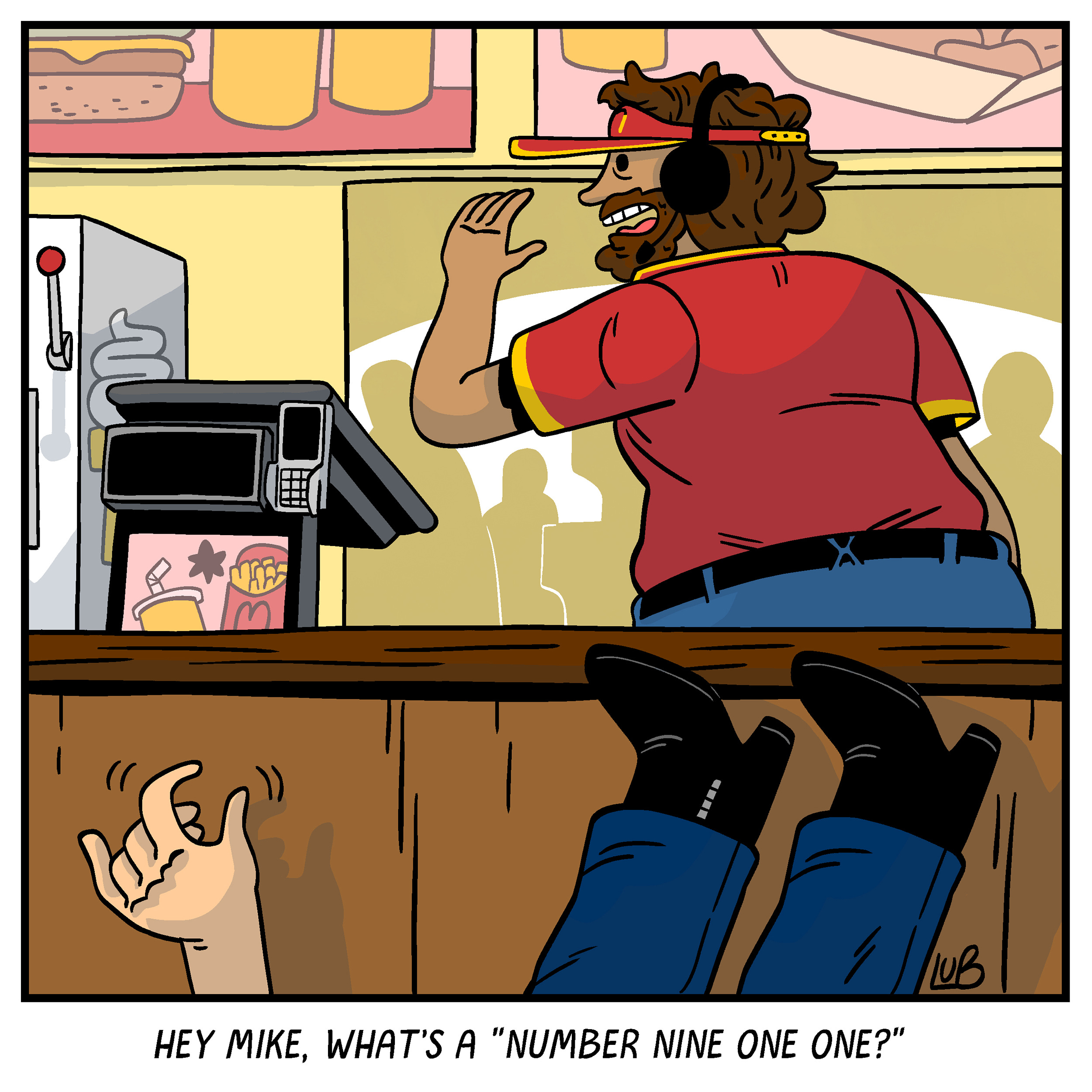
This week, we’re delighted to share an entire chapter (and cautionary tale about ignoring abdominal pain in a McDonald’s) from Maeve Dunigan’s new book, Read This to Look Cool: Essays and Overthinkings.
When I was twenty, I thought about how to execute the “perfect messy bun” a lot. I also thought about laptop stickers. I thought about Lorde and Dua Lipa. I thought about “reclaimed vintage.” I thought about the practicality of wearing high- waisted jeans to an endless buffet dinner. I thought about friends, family, and crushes. I thought about fresh orange juice, McDonald’s coffee, and hard cider. I thought about which “going-out tops” looked best on me. I almost never thought about death.
It’s not that I thought I’d never die, it just didn’t seem like a pressing issue. Death felt like a final assignment due in three months— I’d get to it when I’d get to it! My body was lithe and resilient. Nothing was clicking or sore. My family history of high cholesterol hadn’t yet caught up with me. My gums weren’t yet receding. My skin wasn’t yet plagued with adult acne. I could push through any pain. If I ignored a problem, it went away. I hadn’t yet learned that sometimes, no matter how hard you try to act like everything’s fine, your body will force you to speak up. And so, when my friend Ryder asked if I wanted to get dinner the summer after sophomore year of college, I said yes. I said yes, and I assumed everything would be fine. I said yes, while my body screamed “No!!!!!” I said yes, even though it felt like someone was using a curling iron to style my insides into movie star beachy waves.
Ryder and I have been friends since elementary school. Meeting him on the playground, I immediately liked him because he had the body of a child and the interests of a seventy-five- year- old widower. He was curious in a way that’s usually reserved for fictional children who solve crimes. While most of us spent seventh grade cutting our vacation Bible school shirts into crop tops, Ryder was busy at various backyard excavation sites, using his mom’s gardening shovels to unearth antique perfume bottles, later documenting their historical significance in meticulously kept notebooks. Ryder and I were inseparable through high school, in large part because I was very nosy, and Ryder was very good at figuring out which teachers were hooking up.
We went to different colleges and did our best to stay close. But after two years apart, I was still managing the realities of distance. We were no longer fixtures of each other’s lives. Our daily texts became weekly texts became monthly texts. It was a difficult adjustment, but an expected one. Unfortunately, I’d been handling our changing friendship with the stubbornness of a pottery student unable to accept that her increasingly misshapen vase was actually more of an avant-garde coffee mug. It was a vase! If I just forced it to be a vase, it was a vase!
Home for the summer, I intended to replicate the carefree days of our youth. Things would be exactly the same. How I acted in those few precious weeks would be how he’d remember me when we were apart for the next six months. I planned to be fun, spontaneous, untroubled.
And so, in an effort to be chill, laid- back, and down for anything, I became someone whose appendix ruptured in a McDonald’s.
It wasn’t until I lost my appendix that I became obsessed with it— like an unemployed indie band drummer who breaks up with you and then, realizing you’ve moved on, texts, “Hey babe, I’ve done some thinking, can I buy you a High Life later?” I wanted to know everything about the one that got away.
I learned that in 1735, an eleven-year-old named Hanvil Anderson swallowed a pin. Shortly thereafter, he became the first patient in recorded history to undergo a successful appendectomy, performed by Dr. Claudius Amyand at St. George’s Hospital in London. In his abstract, Dr. Amyand wrote that the boy’s problem involved “a fistula between the scrotum and thigh terminating into it, which for a month last past had discharged a great quantity of an unkindly sort of matter.” I have no idea what that means, but I love that back in those days, doctors could write stuff like “unkindly sort of matter,” and everyone was like, “Totally.”
Two hundred and eighty- one years later, in 2016, I swallowed a Chicken McNugget. Shortly thereafter, I became, approximately, the one billionth patient in recorded history to undergo a successful appendectomy, performed by a doctor whose name I can’t remember, but that my mom thinks was “Defrilio or Demilio or something,” at Howard County General Hospital in Howard County, Maryland.
One of the better bearded guys in history, Charles Darwin, hypothesized that the appendix was a functionless organ. He thought it was likely used as a mechanism for breaking down plants, left over from when humans ate mostly plants, but that it slowly shrank into obscurity as diets evolved. This sounded like a good guess, and Darwin, a famously huge nerd, seemed like a reliable person to trust. For years, his appendix theory prevailed. And so, the appendix developed its reputation as the body’s most inconvenient wallflower. An organ that sits dormant and rarely rocks the boat, too timid to speak up for itself, until, tragically, it’s too late.
In terms of places your appendix could rupture, the best would probably be within feet of—or even better, comfortably inside— a hospital. The worst would probably be in the last row of coach seating on a JetBlue flight during turbulence with a screaming baby and an annoying flight attendant, where the only in- flight entertainment options are nineties rom-com named something like The Ella Question.
Compared to that worst-case scenario, the fact that my appendix ruptured in a suburban McDonald’s seems almost optimal. At the time I didn’t see it that way.
Earlier that day, Ryder picked me up in his mom’s Subaru, waving from the window. I waddled toward the car, attempting to project Cover Girl while surely giving corpse.
Sitting through a bumpy car ride was an exercise in torture, but eventually we pulled up to our destination, and I managed a smile. It was genuinely comforting to see the iconic yellow and scarlet of my childhood. Our hometown is charming, but it’s also the type of town where the McDonald’s is a restaurant restaurant, if you know what I mean.
As we took our seats in one of the familiar, sticky red booths, we started gossiping, just like old times. Pretty soon, my worries about maintaining a perfect vibe began to fade, just as the devil reclenched his lava- hot fist around one of my organs.
If I could just suffer through this mysterious ailment and get to the other side, I’d know that I hadn’t wasted one of our few evenings together. It didn’t matter that I wasn’t having a good time. If I could force a feeling of joy into our hangout by maintaining this façade, it would eventually become a fond memory…right?
As my internal panic raged, Ryder filled me in on the twisted lives of every member of our graduating class. Through increasingly blinding pain, I tried to keep up.
“Remember Becca DeMalo?”
“Ummmm, no,” I sputtered.
“She moved back here and she’s dating the manager of Ship’s Cafe.”
“Oh, okay,” I said, barely forming syllables.
“Remember Cassidy Mays?”
“Is that the girl who wrecked a Jeep?” This was a guess—most girls at our high school had done this.
“That’s her older sister. Cassidy got fired from Dick’s Sporting Goods for being on drugs.”
“Gotcha,” I whispered, pondering who might give speeches at my funeral.
“Remember the guys who got high on Robitussin in the bathroom every Tuesday and called it ‘Tussin Tuesday?”
“Yes, but…I have to go to the bathroom!”
Fleeing before Ryder had a chance to react, I waddled into the bathroom, slammed the stall door, and began frantically Googling. “Stomach bad what happen??” “Stomach feel terrible— death???” Every search hit pointed toward the appendix, which I learned can become blocked, leading to a buildup of bacteria, leading to inflammation, which results in a rupture.
Still confused, I begrudgingly clicked on another one of the links and learned that while the “blockage” scenario is one possibility, it’s not the only cause of appendicitis. In fact, when it comes to appendicitis, much like my cat’s propensity to randomly vomit, there are so many potential causes that it’s hard to pinpoint exactly why it’s happening.
My first instinct upon realizing something might be really wrong was to follow the advice dispensed by so many of my youth soccer coaches— the tried- and- true method known as “walking it off.”
As I limped across the restaurant, I recalled a moment during freshman year of high school when I was plucked from the chorus of our spring musical, The Wedding Singer, along with two other girls, and promoted to a “special” role— we would now be playing ditzy prostitutes who had no lines. Despite having zero sexual experience, I did a good job. Such a good job, in fact, that the director told the other girls to “mimic what Maeve is doing.” This inflated my ego for years to come and is why, even as I dragged my body zombielike toward the fountain soda machine, I was positive my acting abilities were so convincing that no one noticed a thing. Sure, my organs felt like they were knotting themselves into an intestinal friendship bracelet, but that was no matter! A true actress can overcome anything!
I knew Ryder would be understanding if I told him what was going on, but I didn’t want him to have to be understanding. I wanted to prove to myself that I still had a handle on my body. I was the arbiter of the day, not some stomachache. To admit my pain would be to relinquish the control I’d sweatily maintained through my Oscar- worthy performance. And so, after walking it off didn’t work, I gritted my teeth and suffered through tiny bites of fries, anxiously awaiting the moment I could attempt my ingenious backup plan— a similarly foolproof method known as “sleeping it off.”
I resumed catching up, to the best of my ability, as if nothing happened. After what felt like hours but was realistically about forty- five minutes, Ryder and I headed home, promising to meet up the next day. Unfortunately, when the next day arrived, I was in a sweaty fetal position, feeling ten times worse. I finally gave in and did what any competent adult would do— I called my pediatrician, who sent me straight to the emergency room.
Heading to the ER, my mom warned that the person at reception would ask what my pain level was on a scale of one to ten. The key, my mom said, was to tell the receptionist a number that was three higher than my actual pain level. This would ensure I didn’t sit in a crowded emergency room for very long. I hated this idea for all the obvious reasons— having to lie, potentially putting myself ahead of someone needier— but more than that, I hated it because, even with these new parameters, I still had no idea what to say. Sure, it was the worst pain I had ever felt in my life, but thus far I’d enjoyed such an easy life! What constituted a ten, anyway? Childbirth? Having your arm sawed off? A never- ending UTI? I needed more concrete examples of ones and tens. “On a scale from the feeling when a nail technician is ripping off little bits of your cuticles to literally being set on fire, where is your pain?” That would have helped.
Aside from the logistical nightmare of assigning a numerical value to my pain, there was also the social nightmare of having to admit that I was in pain at all. I mean, wouldn’t it be sooooooo annoying to everyone at the hospital if I told them I was experiencing a medical emergency? They’re busy! They’ve got a packed day of scrubbing their hands and yelling, “Scalpel!”
I only had one organ that was failing— surely, I thought, there were people here with three, four organs that were shutting down. What if someone accidentally got their hand stuck in a NutriBullet? How serious would my problems seem, a girl whose hand was still clearly affixed to her wrist, if I asked for help?
I’d never been taught to realistically evaluate my pain. I understood debilitating monthly cramps, bloating, and headaches to be normal things people with bodies (usually female bodies) just had to deal with. Period woes, no matter how extreme, did not constitute a sick day. Then again, if it was ever something more dire, I was taught that doctors wouldn’t believe me unless I exaggerated, unless I added three to the scale. On each end, my fate was determined by a performance. Either I pretended nothing was wrong so that I wasn’t a burden, or I pretended things were worse than they were so that I could be taken seriously. It felt like there was no middle ground. But as the agony intensified, I was forced to reckon with the fact that burdening the doctors with my medical issue was probably better than burdening them with my corpse littering their waiting room floor.
And so, tears pooling in the corners of my eyes, clutching my stomach, practically hallucinating, I looked at the receptionist and shakily said, “Seven?”
Fifty minutes’ worth of passive- aggressive glances from my mother later, they called me back.
They told me the pain was either appendicitis or an ovarian cyst. If it was an ovarian cyst, it would probably go away on its own. If it was appendicitis, I would have surgery that night.
“Please, please let it be an ovarian cyst,” I pleaded with any God who would listen— all of whom were probably like, “Ew, gross.”
McBurney’s point, which sounds like the name of a seaside vista where teens go to make out, actually refers to the location on the right side of the abdomen just above your appendix. McBurney’s sign, which sounds like a hand signal teens give to each other when they wanna sneak away to McBurney’s Point and make out, is used to describe the feeling of intense pain located at McBurney’s Point, and is a common indicator of appendicitis.
When the nurse pressed hard on McBurney’s Point, two things immediately became clear: I definitely had appendicitis, and I was going to murder the nurse.
I wish I knew that nurse’s address so I could send her one of the more expensive Edible Arrangements available for purchase. Because, after enduring blistering pain by her hand, I became, as the French would say, a huge cunt. She was only doing her job, which was saving my life, and yet the second she pressed on my abdomen I thought, Women shouldn’t be doctors.
I’d finally reached a pain threshold that forced me to drop the act— a level of discomfort that broke me out of the performance I’d been so adamantly maintaining. With one press on my abdomen, I went from “No worries if not!” to “I’ll chat with your superior later”— rocketing to the opposite end of the white- lady spectrum.
“I don’t understand why I can’t have any water,” I fumed, the first time all day I’d complained about anything. She calmly explained that I wasn’t supposed to drink fluids before surgery, but that she would give me water through an IV so I wouldn’t feel dehydrated. “It’s not the same,” I said, in a tone that implied I genuinely believed this medical professional didn’t understand the differences between drinking water and having it pumped into your arm.
To be fair, I can’t imagine the nurse felt particularly offended. It’s hard to take anyone in that much pain very seriously— never mind a girl who, at this point, had sweated through her college sketch comedy group T- shirt and was high on Percocet for the first time, repeating over and over that she was “just like Lil Wayne in that Chance song.”
I never actually asked to speak to that nurse’s superior, nor did I say or do anything to her beyond rolling my eyes and melodramatically asking for my cot to be pushed closer to where my phone was plugged in. But, in an albeit misguidedly annoying way, I was finally speaking up for myself. I was finally telling people what I needed and how I felt. I had finally stopped caring about how I was coming off to others. I was also still being pumped full of drugs and beginning to think my skin was made of baked potato.
The thing about telling people how you feel is that it allows them to help you. (Groundbreaking, I know!) I’d been working so hard to navigate this no-man’s-land, somewhere between the selfishness of worrying what others thought of me and the altruism of worrying about being an inconvenience, and I wasn’t getting anywhere. I would never have stopped if my body hadn’t forced me to.
It turns out, my appendix was also doing more work than anyone thought. In 2007, researchers came up with a compelling theory for its role in our bodies. The appendix, they hypothesized, doesn’t just collect bad bacteria, it also acts as a storage space for helpful bacteria, thus aiding our digestive and immune systems. The appendix doesn’t just sit around, twiddling its thumbs— it tries to keep us alive.
The appendix, in its own way, serves its larger body by doing the little bit that it can. As I learned more, I felt a strange empathy for this organ that’s trying its best. This organ that keeps doing its job even at the expense of its own functionality, that naïvely believes it can keep going and going and never burst. That eventually gives up, does a complete 180, and burns everything down.
I like to think my appendix had six Gibsons served by the hot bartender who works in my intestines and then, cocktail onion crunching in her teeth, enlivened by an intoxicated, violent complex was like, “You know WHAT? YOU KNOW WHAT??? I HATE being here! No one respects me! I’m not getting any work! In another body, I’d be a STAR! So that’s it, I’m LEAVING!” And then she stumbled her faux leather booties toward the door, never to be seen again.
God, I miss her.
Staring at the bright lights of the operating room, I had the urge to ask if they could put my appendix in a jar for me to take home. But then I remembered this was Howard County General and not medieval Europe and there was no way they’d let me do that.
Plus, I was so high that I couldn’t think of the word “jar.”
“Imagine you’re on a beach,” the anesthesiologist said. “Which beach are you thinking of?”
In a drugged haze, I closed my eyes and tried to find a beach. But the only location appearing on the fuzzy map in my brain was the one where my best friend Jackie had just studied abroad.
“Madrid,” I said, confidently.
“WAIT!” my eyes shot open as my last brain cell worked overtime, realizing that Madrid is not a beach at all, but a landlocked city in Spain. This anesthesiologist was going to think I was an idiot. “Actually, I meant—”
And then everything went black.
The day after the surgery, Ryder came to visit me in the hospital.
“I can’t believe you made it through that whole dinner,” he said.
I couldn’t believe it either. I’d waited so long that my appendix, pushed to its limit, had unexpectedly burst open during surgery, forcing me to stay in the hospital an extra day. I’d made it just in time.
What would’ve happened if my body and brain had worked as a team? If I’d listened to what it was telling me, instead of insisting everything was fine? If I hadn’t been so afraid of maintaining this perfect act? If I knew how to tell people the truth? Maybe everyone’s day would’ve been easier if I hadn’t been so focused on shrinking my problems to make their day easier. Maybe I’d be home by now.
“Anyway,” Ryder continued, scrolling his burner Instagram. “Remember Julie Frank? I think she stole her ex’s pug.”
Maeve Dunigan is a writer, comedian, and frequent contributor to the New Yorker. Her work has appeared on NPR’s Selected Shorts, McSweeney’s Internet Tendency, Reductress, Mic, Mountain Gazette, and (to her great surprise) a high school textbook. She recently published her first book, Read This to Look Cool: Essays and Overthinkings.
Mattie Lubchansky is an American cartoonist and illustrator. She is the former Associate Editor of Ignatz and Eisner award-winning magazine and website The Nib. Her graphic novel Simplicity (2025) was a national bestseller and her debut, Boys Weekend (2023), was named a best book of the year by NPR and The Washington Post. She cohosts the No Gods No Mayors podcast with Riley Quinn and November Kelly.
 | A guest post by
|