
Infusion Diaries: The Line
On nursing and care.

When B* slides the needle into the crook of my elbow, it goes in like a whisper. I don’t feel a thing.
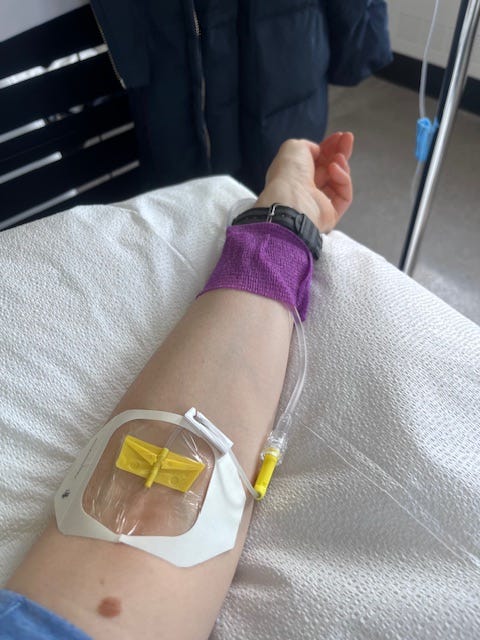
(*I’m abbreviating B’s name because it’s distinctive, and I’m not sure how she feels about being perceived, even if it’s for being VERY GOOD AT HER JOB. I’m aware that I frequently use “B” for my cat Beatrice, but, despite her nursing certification, she lacks opposable thumbs, and I have faith in your ability to read context clues.)
B is the nurse manager at this center. When she took me back for this infusion — only my second in this location — she not only remembered me from eight weeks ago but the fact that I had been assigned the exact same chair as last time.
I marveled at her memory, and she chuckled quietly, shaking her head. “It’s kind of a curse,” she said.
We chat as she secures several bags of clear liquid (soon to be trickling into my veins) on my rolling IV stand. Taking care to prop up my arm, B inserts my line with a practiced hand and then, in a trick I’ve never seen before, gently binds it to my wrist with a strip of gauze.
“Makes it easier to get up and walk around,” she winks. She adjusts my drip rate; we banter a bit about the incoming dose of Benadryl; and I settle in for the long haul.
I’m thinking about the countless nurses who have inserted my IVs, drawn my blood, taken my vitals, and entered interminably long lists of my medications into my chart over the years. Whether you’re doing routine maintenance for a chronic illness or some kind of emergency has torn a rift in your life, people like B — the ones who take care of you — can occupy an outsized place in your memory. Perhaps this is why I felt so touched that B had already cleared a spot for me on her mental shelf.
(It gets better: while texting our own Ian Goldstein from the chair, I confirmed that he used to get iron infusions from B too. When I passed on a tentative hello — “I’m not sure if you remember . . .” — she recalled him immediately: “I love Ian! That’s my guy!" Ian hasn’t been in for an appointment since last April.)
We tell a lot of comic horror stories on this Substack, but I can’t overstate how radically these touches of attentiveness and warmth from those doing on hands-on care — from cracking a joke to asking your preferences to gently holding a finger to your skin so it doesn’t get pinched — shape our encounters with the medical system.
And, in that spirit, I’m thinking about Alex Pretti, the 37-year-old ICU nurse murdered by ICE in Minneapolis yesterday.
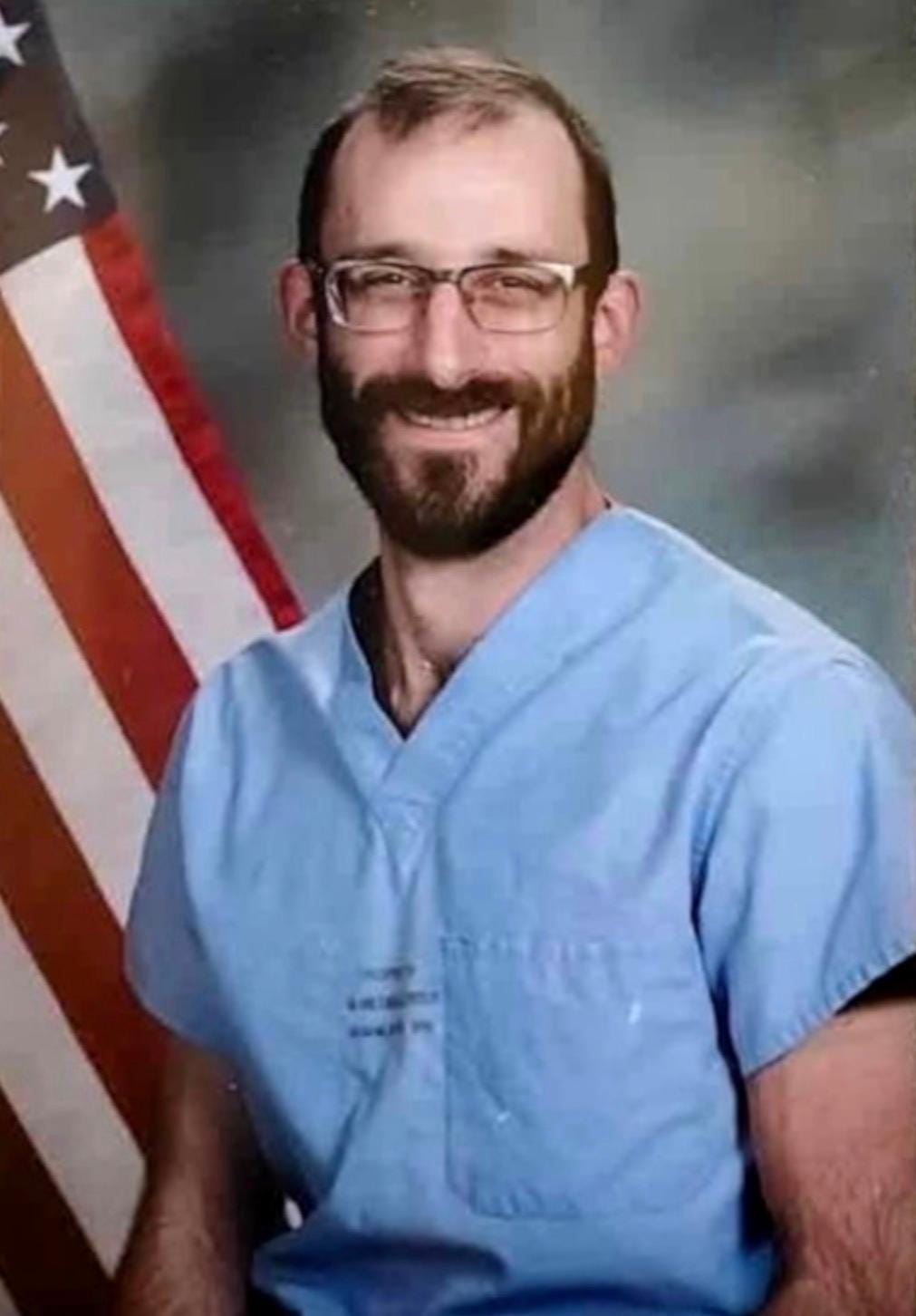
By all accounts, Alex Pretti was a profoundly good man. He shouldn’t have to have been. You should be able to be a proverbial horse thief without being beaten and executed in the street by agents of the state.
But Alex Pretti was an intensive care nurse who worked in the VA Hospital, caring for a patient population in great need. He held hands, placed lines, supported his colleagues, helped terminally ill patients live out their last moments in comfort and dignity, and consoled their loved ones as they said goodbye.
That’s sacred work. And I know his surviving patients and their families remember him.
This entry was not something I planned or wanted to write today. But, even before yesterday’s events, I watched my IV bags drain under B’s calm supervision and thought that there’s nothing that disabuses you of independence quite like needing another person to stick a tube in your arm. For the next three hours, I am tethered not just to the medicine, but to B — the human being monitoring my care, opening my body up and keeping it safe.
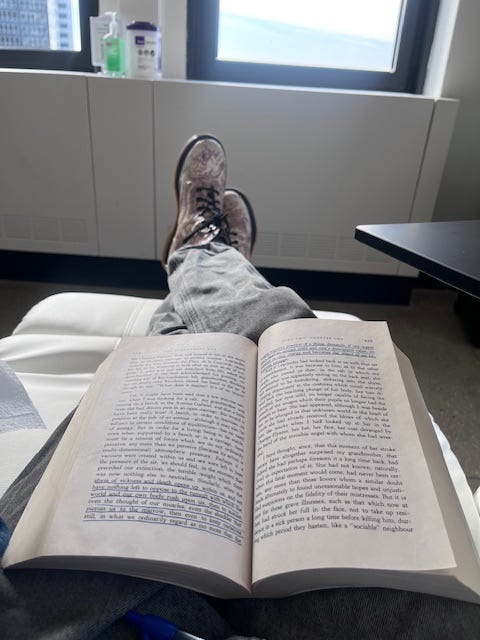
At the risk of self-parody, it reminds me of a chapter from Moby-Dick.
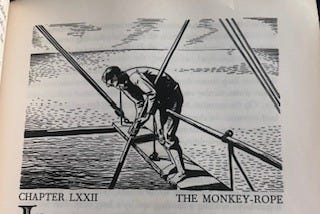
The titular “monkey-rope” is a literal cord that extends from Ishmael’s waist to that of his shipmate (and lifemate) Queequeg. While Queequeg stands atop the floating whale to strip it, Ishmael stays aloft, using the rope’s tension to keep them both in place. If one of them falls, both will pulled into the water and drown.
Always the philosopher, Ishmael is not one to miss the metaphor:
“I saw that this situation of mine was the precise situation of every mortal that breathes.”
It is not a warm-and-fuzzy thing to be bound to one another. It’s frightening. It’s risky. Yet the tethers between us remain and may be the only things keeping us on our feet.
Let us actively choose to perceive the lines. And, like Alex Pretti, Renee Good, and thousands of others rallying against fascism in subzero temperatures on the streets of Minneapolis, let us use them to hold each other up.