
A World of Hurt
Written by Abby Norman / Illustrated by Cara Ziruo Wang


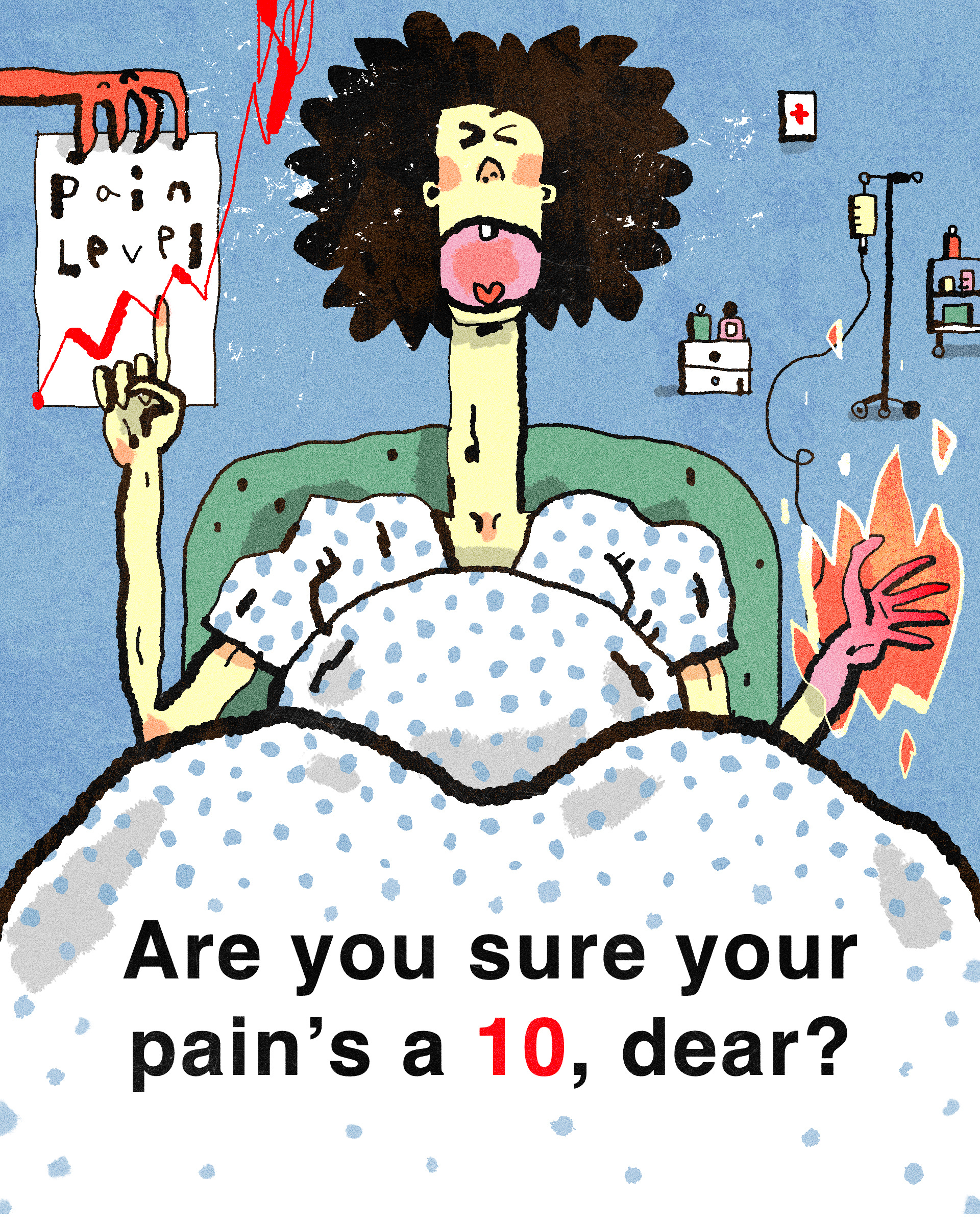
In the 1940s, a group of researchers at Cornell University was trying to come up with an objective method to use to measure pain. They suggested that a person’s pain threshold be measured in a unit they called the dol, which was short for “dolor” — Latin for “pain.” Once they had a name, they had to figure out what a dol actually was. The only way to do this was to design experiments that intentionally inflicted various types of pain onto human subjects, then scale them accordingly. So that’s exactly what they did: they came up with over a hundred different experiments using various pain-inflicting stimuli. As they reached the upper limits of pain, however, they were confronted with a very obvious problem. To understand pain at that level, they’d have to truly injure a subject, and the margin of error for something like that would have no doubt been very small. What they needed was a highly painful experience that wasn’t going to maim or kill anybody, and that they could easily observe. And that’s how researchers from Cornell found themselves in the obstetric wing of New York Hospital, burning the hands of laboring women . . .
The experiment went like this: as the thirteen women in the study labored, in between contractions, the researchers would burn one of their hands with a thermal device calibrated to deliver varying levels of intensity. The researchers had set the value of a dol as “approximately one-tenth the intensity of the maximal pain,” which they were hoping the experiment would help them establish. What they really needed was for the women to be able to compare not just the intensity of the two types of pain, but both their qualities. Of course, as the labor progressed, the women were understandably less communicative than at the outset, and so the researchers made inferences about their pain experiences by noting their behaviors, “such as crying, complaining, sweating and degree of alertness and cooperation.” Not surprisingly (to many women, anyway), the pain experienced by at least one of the women achieved the maximum value for the dol pain-measurement scale—a 10.5. what the researchers called “the most intense pain which can be experienced”
These experiments in calorimetry provided a lot of fascinating data about pain, and it scientifically confirmed what women had known for millennia: that childbirth can push beyond the perceived limits of the human pain threshold. It did not, however, provide medicine with the kind of objective measurement it needed in terms of pain assessment. As compelling as the dol studies were, they still relied on the patient’s willingness and ability to report their pain — which is inherently subjective.
This is an excerpt from Abby Norman’s book, Ask Me About My Uterus: A Question to Make Doctors Believe in Women’s Pain
This was illustrated by Cara Ziruo Wang
 | A guest post by
|
This is so ridiculous
Oh my god, this world. Love the illustration💥